Author Business Strategy
Structure your writer business like a pro

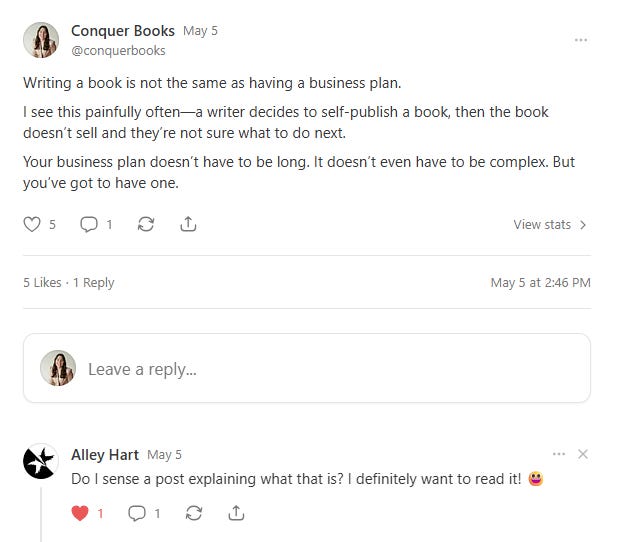
Yes, as Alley Hart guessed, I am talking again about author business plans.
I’ve shared in the past why business plans are important for writers and what you might put in yours.
In this post, we’re moving onto Round 2: Author Business Strategy. I believe in making business decisions based on data and with intention. I’m going to share major takeaways to help you better visualize a successful business plan and to move forward with action.

How Many Books Should You Sell?
For novice authors, the answer to this question is loose. It’s typically, “A lot.” Or, “However many I need to become successful.”
Experienced authors are more specific in their answer:
“I want to double the number I sold last year.”
“I plan on selling 2,000 books.”
“I’d like to sell at least 50 books per live event.”
They have a better understanding of what has worked, and what new tactics they’re trying this year. If you’re new to thinking about your author business this way, it’s helpful to first get a sense of what your short-term and long-term goals are.
How to Approach a Goal
Writers don’t often believe me when I tell them everyone’s goals are different. They think every writer’s ultimate goal is to write full time. Or hit the NYT Bestseller List. Or give a commencement speech. Or become an independently wealthy recluse living in Scotland.
As a book coach who has seen the insides of hundreds of author careers, let me tell you, you all really do have different ideas of what success looks like.
Your first step is to get specific about your short- and long-term goals.
For example:
Short-term goal: Hit the top 50 on an Amazon sub-genre list
Long-term goal: Hit the USA Today Bestseller List
Or:
Short-term goal: Make $2,000/year from your writing
Long-term goal: Make $100k/ year from your writing
Why have a short-term goal? Why not just shoot for the stars? Well, as I tell my son, you can’t travel the world before you can pick up your socks.
Plus, when you understand what you’re targeting, then you can look at what kind of work it takes to get there.
Short Term Example #1
If we wanted to dive into the short-term goal in the first example, we could use Kindlepreneur’s Kindle Best Seller Calculator to see how many books you need to sell to reach your goal. For example, I used it (pictured below) to see how many books a writer has to sell to hit the Top 100 in the Kindle store.
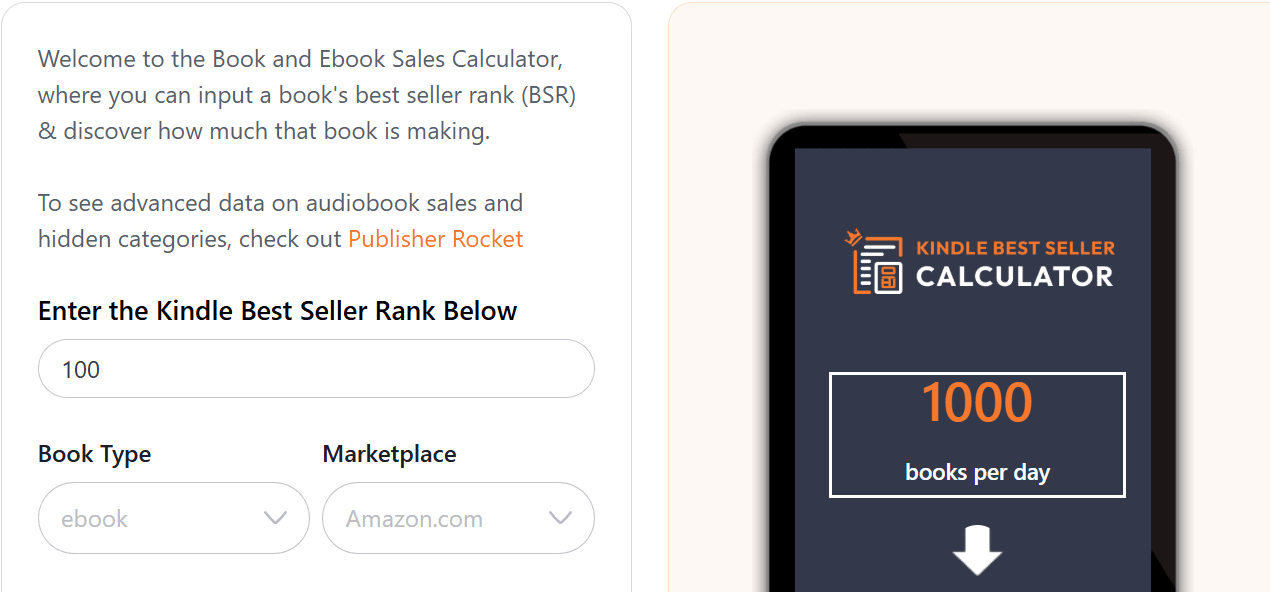
The answer is 1,000 books.
But that wasn’t our question. The identified short-term goal was: “Hit the top 50 on an Amazon sub-genre list.”
So, an author might say, “Wow, K.F. Breene’s Magical Midlife Madness is ranking #41 in humorous fantasy. I’d love for my funny fantasy book to do the same. How many books do I have to sell to get that kind of result?”
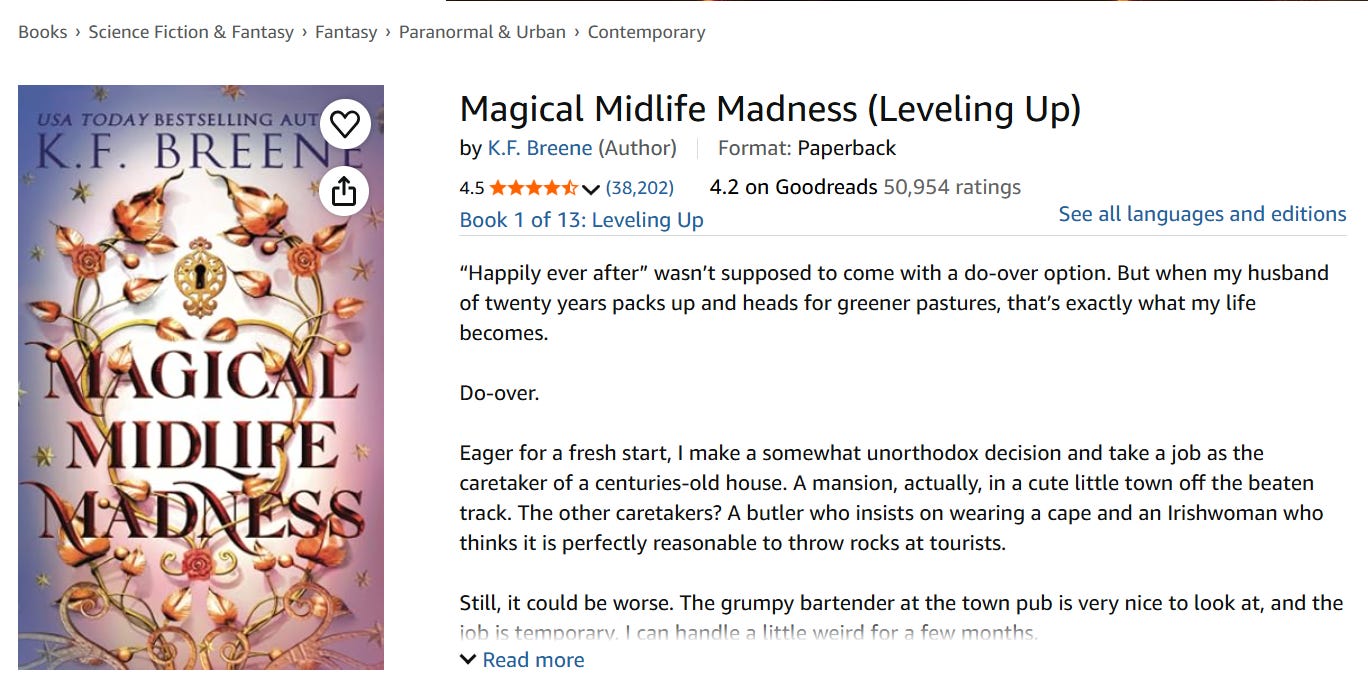
If you use the overall store ranking for that book with the calculator, you’ll see that this title is selling about 4 copies every day. While that doesn’t get the title into the Kindle Top 100, it gets it into the top 50 of a great sub-genre list.
After you do your research, your next step is to strategize how to sell 1,500 copies/year.
Short Term Example #2
In our other example, the author’s goal is to make $2,000 off their writing in a year.
They could do the math (if I sold X e-books and make Y off each one…) but I find that saying the number of books they want to sell doesn’t make it happen.
Instead, let’s look at the habits of authors making $2,000+ via the Written Word Media Indie Author Survey 2025.
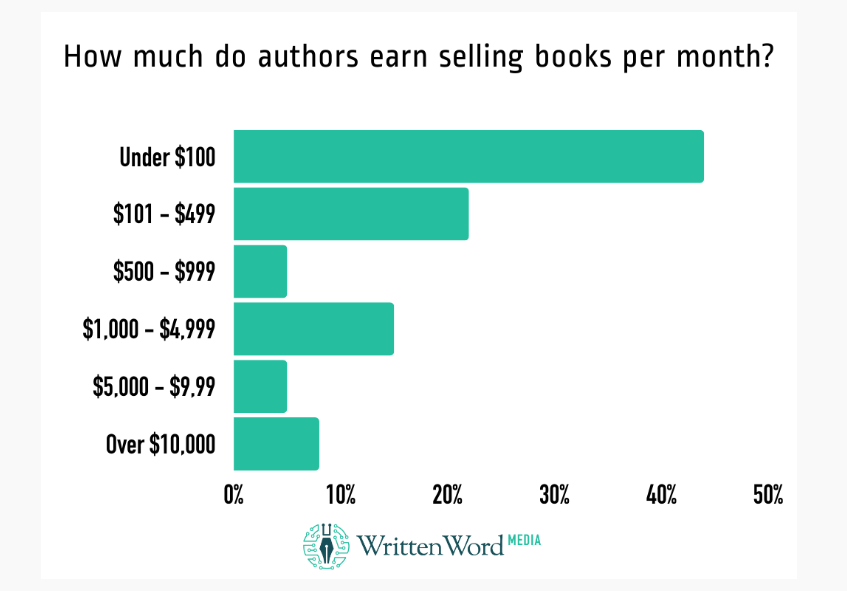
To hit that goal of $2K/year, you need to be in the top 50% of indie authors. We might ask ourselves then, what are those authors doing that you’re not?
The Written Word survey shows that authors working at that level probably spend $150/month on marketing, have an e-mail list of 1,000 subscribers, and have published 10 books. So, now you know your next step is to test paid marketing, start a newsletter, and write your next book.
Those are broad markers for the kind of work a writer is putting in to get a certain result, though of course everyone’s exact path looks different. I highly recommend looking through the survey, even if you are or plan to go trad.
Buckets & Funnels
To hit those long-term success goals, it’s likely you’re going to develop multiple funnels for new readers to find you and multiple buckets for them to pay into.
Those funnels might look like:
Social media
99 cent e-book sales
BookBub or other promos
Facebook ads
Live events
Podcast tours
Newsletter reader magnets
Then, there might be a variety of buckets readers and supporters can use to pay you:
Various formats of the book
Patreon/Kickstarter/Substack subscriptions
Speaker fees
Merch like stickers, mugs, or sweatshirts
Freelance writing or editing
To determine your funnels and buckets, you’ve got to experiment. To keep yourself from spreading too thin, I suggest following these guidelines:
Set budgets for specific projects. If you want to try paid ads, set aside a specific amount each month that you can experiment with. If you feel author fairs might be your thing but haven’t done one yet, invest in tablecloths and book holders before you upgrade to pop up signs and high entrance fees.
Record number of followers. Track your follower numbers or other metrics for social media and other marketing efforts. That way you can tell if your time and/or dollars is a good investment.
Find where the money is coming from. Make sure your accounting is accurate and done on a weekly basis if possible. Periodically compile the data and look at trends. Are you selling more print books than e-books? Might be time to try a special edition. Did that Kickstarter cost you money because of unexpected hiccups? Get solid on your numbers so you learn from the experience.
Along the way, think expansively about where income can come from. Here’s a few surprising examples from my own indie author experience:
Auctioned character naming rights - $500
My Life’s Work, a set of each of my books - $100 every sale
Milage deductions - $1,200 annually
Organized a local author fair in my town when there was none - $600 annually
Curated a list of Indigenous books - $120
Two Mindsets
Recently, my city announced a grant to help resettle out-of-state artists in our corner of Wisconsin. The funds came from a state pot that was typically used for ads but a group of area non-profits wrote a grant to instead use the money as relocation support.
A lot of creators in my area were upset. They felt they weren’t being supported enough and these funds were going to the wrong people. There was a lot of negative press and the grant writers had to host a Q&A.
Arts funding in Wisconsin is very low. Last in the country, in fact.
I understand the frustration of these artists and creators. Our systems should be more robust.
But complaining to people who did the work to start a new program? No ma’am.
The nonprofits involved also hosted a local author fair, run an annual visual arts fair, started a new artist-in-residence program, and offer free business consulting. Asking them for more instead of contributing to community efforts felt tasteless to me.
It’s ultimately up to you to make things work.
Writers can fall into this trap of entitlement from time to time. Sometimes we’re just tired. I wish a bookstore would reach out to me instead of having to send all these e-mails. It’s okay to be tired.
But then you’ve got to set that aside and keep your eyes on the goal.
The best results I see come from writers who are dedicated, willing to experiment, and pivot when needed. They don’t wait for someone to invite them to a book fair, when they can apply to one or start their own. They don’t put off running an ad for two years. They do it now so they have results to build upon.
Elevate your results by treating your business plan as a live document.
If you want help honing your business plan, book me for a 1-hour consult. I’ll review your plans and brainstorm strategies, then we can discuss what actions you can take to turn 2026 into your most successful year yet.